Attested · Issue #6
Attested #6: Two million canary prompts, and what ZDR turned out to mean
Dragos seeded fake keys and links into AI prompts for five months. Three provider breaches, prompts forwarded to MiniMax, and OpenRouter pulls 125 endpoints from ZDR
Subscribe on SubstackTwo million canaries
Dragos seeded two million prompts with fake AWS keys and sent them to AI services, then waited to see who used the keys. Each prompt also carried a unique hostname and URL. HD Moore’s team ran the test from July to November.
They found three things.
- Three provider breaches. The biggest took a couple hundred keys, each sent once to one provider in a few late-October windows. Every request in those windows was stolen, even ones rejected before a model ran, so the copying happened at the front door. In the other two breaches, some stolen requests had the ZDR flag set. The keys were then used for tens of thousands of AWS API calls. The earliest breach goes back to mid-July. None of the three providers knew until Dragos told them.
- Sellers reading prompts. No exploit needed. List a model at the lowest price, turn on request logging, and wait. Prompts sent through one seller had their secret URLs opened and SSH passwords tried by hand from home connections. The same model through another seller stayed quiet.
- Privacy settings ignored. A Chinese AI lab’s systems opened secret URLs from more than half the prompts sent to its models. That included about two thirds of the prompts marked “no data collection” or ZDR, usually two or three days later. US hosts reselling its models triggered the same scraper. One link showed up in a Feishu chat 24 days after it went to a US provider with the ZDR flag.
Dragos names no providers. Its Figure 1 key was seeded Oct 21 and first used the next day. Phala’s final report, below, puts the first leaked canary at 03:27 UTC on Oct 21. Phala credits “an independent researcher” and doesn’t say who.
Dragos sums it up: “a privacy flag only binds the first hop.”
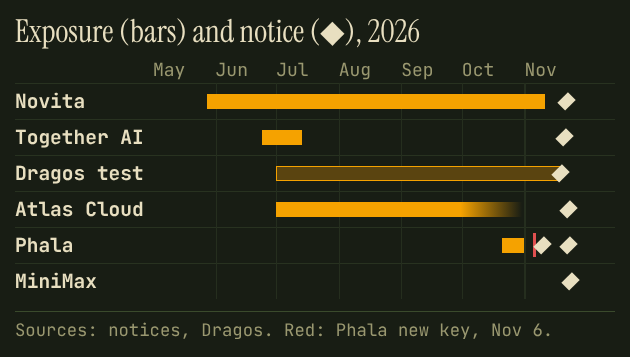
The notices
OpenRouter says it wasn’t breached. It dropped three providers it doesn’t name and took 125 endpoints out of ZDR. It has told affected customers. It plans to run the researchers’ tests continuously and to check network paths for forwarding. Its page lists write-ups from Atlas Cloud, MiniMax, Novita, Phala and Together, and says not every affected provider has posted one. CEO Alex Atallah wrote that providers’ data claims “have mostly relied on self-attestation. This isn’t going to be sufficient.” He added that encrypted TEE inference “will be a great way for providers to accelerate this.”
Novita says some MiniMax requests went to MiniMax’s own API instead of Novita’s servers. Its explanation: “a routing configuration issue caused an API forwarding path intended for specific customers to apply more broadly.” This ran from May 28 to Nov 11. If you used MiniMax models on Novita in that time, directly or through OpenRouter, your requests “may have been accessed or retained by a third party.” The researcher saw URLs and hostnames fetched, but the AWS keys were never used. Novita reads that as automated content review. It has suspended the models.
Atlas Cloud says a third party opened links from prompts after they reached MiniMax’s API. That includes MiniMax M3 and M2.7 prompts it forwarded in Q3 and early Q4. It no longer sends anything to MiniMax. It tells M3, M2.7 and M3.1 Flash users to treat any secrets they sent as exposed. It also pulled all its models from OpenRouter until they pass its own tests, and says that was its call, not OpenRouter’s. HD Moore now tests its models four times a day.
Together AI had a different problem. It kept prompt samples from MiniMax M3, GLM-5.2 and Kimi K2.6 requests in a private Hugging Face repo for testing. Most come from four days in June and July. “An AI coding agent committed a credential” for that repo to Together’s public xorl GitHub repo. Someone used it to download the samples and try the credentials inside them. Five were Dragos canaries. Together now uses short-lived credentials and turns ZDR on by default for new accounts.
MiniMax says the requests came straight from OpenRouter or through Novita, StreamLake and Atlas Cloud. Its security monitoring, on by default for those endpoints, pulled URLs out of the traffic. Its “internal security programs and agents” then opened some of them, including URLs from ZDR and no-data-collection requests. It has switched that off and deleted the logged URLs. It says it found no sign that prompts or responses reached third parties. Its ZDR still keeps “invocation and usage records.”
Phala’s final report replaces the preliminary one from #5. The exposure window is now Oct 21 to Nov 1. In that time 152,092 OpenRouter requests, 0.45% of Phala’s inference traffic, hit one experimental DeepSeek V4 Flash 0731 server. The attacker got in through a monitoring login with a default password. From inside the CVM, they reached a host VMM that asked for no credentials. The CVM ran in real TEE mode, but on the development image, with SSH. The line that matters here: “Our gateway treated it as a plain OpenAI-compatible endpoint, so it never checked the server’s attestation.” By Nov 21, 2,179 of 2,271 CVMs had moved off the stolen KMS root key. The 509 apps that derive keys with getKey() still have to move their own assets. Phala now sends OpenRouter traffic only to attested production backends, and says it will run its own canaries.
None of this was a TEE failure. It’s what inference looks like when the only control is a policy page and a flag the next hop may ignore. The site explains ZDR vs attested, compares what each router promises, and logs all of the above in the incident tracker.
The caveat for our side: a TEE quote proves where a model runs. Only 9 of the 86 checks below bind your request to the attested backend. A router that terminates TLS in front of an enclave can still read the prompt.
Shipped
Tinfoil Bunkers are always-on sandboxes for agents, each in its own confidential VM. Credentials sit in a separate CVM, the Perimeter, on different physical hosts. All Bunker traffic goes through it, so an agent can use a connector under a policy without holding the secret. Each Bunker’s attestation binds its owner’s key into a launch config on a shared measured image, so one Bunker can’t pose as another. The post gives no pricing.
Confidential AI opened Confidential Cloud in public beta. It rents TDX and SEV-SNP CPU VMs by the hour, and VMs with up to eight confidential B300s. The 8-GPU node is $60 an hour. Its inference API also gained a stateless /v1/responses route, per the changelog.
dstack 0.6.6, which Phala Cloud runs on, has two changes that follow from #5. Apps can now reach keys from before a KMS root key rotation, which Phala did on Nov 6. And the KMS and verifier now check SEV-SNP TCBs against AMD’s per-CPU minimums and reject ASKs on AMD’s revocation list. So a KMS can refuse keys to CVMs on hosts below the levels in AMD’s bulletins, including the ones for Mior and Skyfall. One catch: an SEV-SNP KMS won’t serve SNP requests until that TCB list is published, so operators have a step to do before upgrading. dstack 0.5.16 brings the old-key access to the 0.5 line.
At Ignite, Azure showed confidential bare metal on one Vera Rubin node with four GPUs, running a 397B model on vLLM. A local verifier checked it. Microsoft calls remote attestation “an architectural direction.” Rubin confidential VMs, confidential containers on AKS and Foundry integration are still in development. For now Microsoft points customers to its H100 confidential VMs. Also announced: a gated preview of SEV-SNP “Turin” v7 VMs, TDX confidential AKS nodes on Azure Container Linux, and SEV-SNP VMs on Azure Local, the last two generally available. A confidential GPU preview for Azure Local is “coming soon.”
New names I’m looking at
Red Router sells abliterated and open models for offensive security work. Its confidential tier promises requests “encrypted to a remotely attested, hardware-isolated runtime.” I haven’t found a public attestation endpoint, so it isn’t monitored.
Anonymo is an uncensored-model gateway. It plans a “sealed” tier that runs only on attested GPU enclaves, puts the attestation on the receipt, and stops instead of falling back. It says the tier isn’t live yet.
Also this week
- BlockJack. Rowhammer flips in vLLM’s paged KV-cache block tables send one tenant’s requests to another tenant’s cached context. That can leak the context or steer the answers. vLLM and Sonar confirmed it and proposed patches. A TEE around a shared vLLM process doesn’t separate the tenants inside it.
- KV-Cloak broken. KV-Cloak shuffles KV caches to hide cached prompts from operators and co-tenants. Repeated-token probes defeat it. On 3,000 real prompts, the authors recovered the full token multiset on GPU. Two other open-source defenses fall the same way.
- Isonomy. A prefix-cache hit makes the first token arrive sooner, which tells you another request used that prefix. Providers share caches only within one account, but resellers pool many users behind one account. Isonomy, built on vLLM, isolates every request by default and still keeps one shared cache.
- nvtrust 2026.11.16.001. NVIDIA’s Protected PCIe verifier now pins
certifito a trust store without the compromised eMudhra intermediates. If you run your own GPU attestation, check which trust store it uses.
Forwarded this? Subscribe here.
Past issues and live data are on confidentialinference.net. Attestation changes go out on the alerts RSS.
If I got your service wrong, reply and I’ll correct it in public.
Aljaz